One of the most formative events in my life was graduating from Law School into the worst financial crisis since the Great Depression. My future had already been uncertain because I had decided that I wouldn’t practice law, but this took things to a whole new level.
The End of the End of History
Up until that point, the prevailing narrative had been “the end of history” — economics had solved economic crises, every advanced country would inevitably become a capitalist democracy, and the “smartest people in the room” were in charge. Then it all fell apart. There was no return to equilibrium. Things just kept getting crazier.
Looking back, I think that’s when I first felt what so many people feel now: we used to feel like we were standing on solid ground, but more and more we’ve come to realize it’s a thin layer of dirt on top of ice—and the cracks have been accumulating ever since.
Religion gave us a story about why we’re here, but people have stopped believing. Manufacturing gave us physical grounding—we made things, we understood the economy through what we built. But then we stopped building. We offshored the factories, moved to an information economy, and the last stable ground became “knowledge work.” Now AI is putting the nail in that coffin.
The ice is about to break. And when it does, we’ll fall into an abyss of meaninglessness—unless we find something new to stand on.
A New Kind of Theory of Everything
That’s what Swarm Theory is: a framework that reconnects mind, matter, life, and technology into one coherent picture. Not a replacement for religion or ideology. Not a retreat to older frameworks (though we’re already seeing that impulse—socialist revivals on one side, right-wing authoritarianism on the other). This is an attempt at the forward path.
I’ve been developing it for nearly a decade. This is the first time I’m sharing it publicly.
You’ve probably heard the term “Theory of Everything,” but there’s a reason nobody actually uses one to make sense of their life: they’re mathematical abstractions, useful only to theoretical physicists. But I’ve always felt that a theory of everything should mean exactly what it says — a framework that helps you understand everything. That’s what Swarm Theory attempts to be.
The Core Axiom
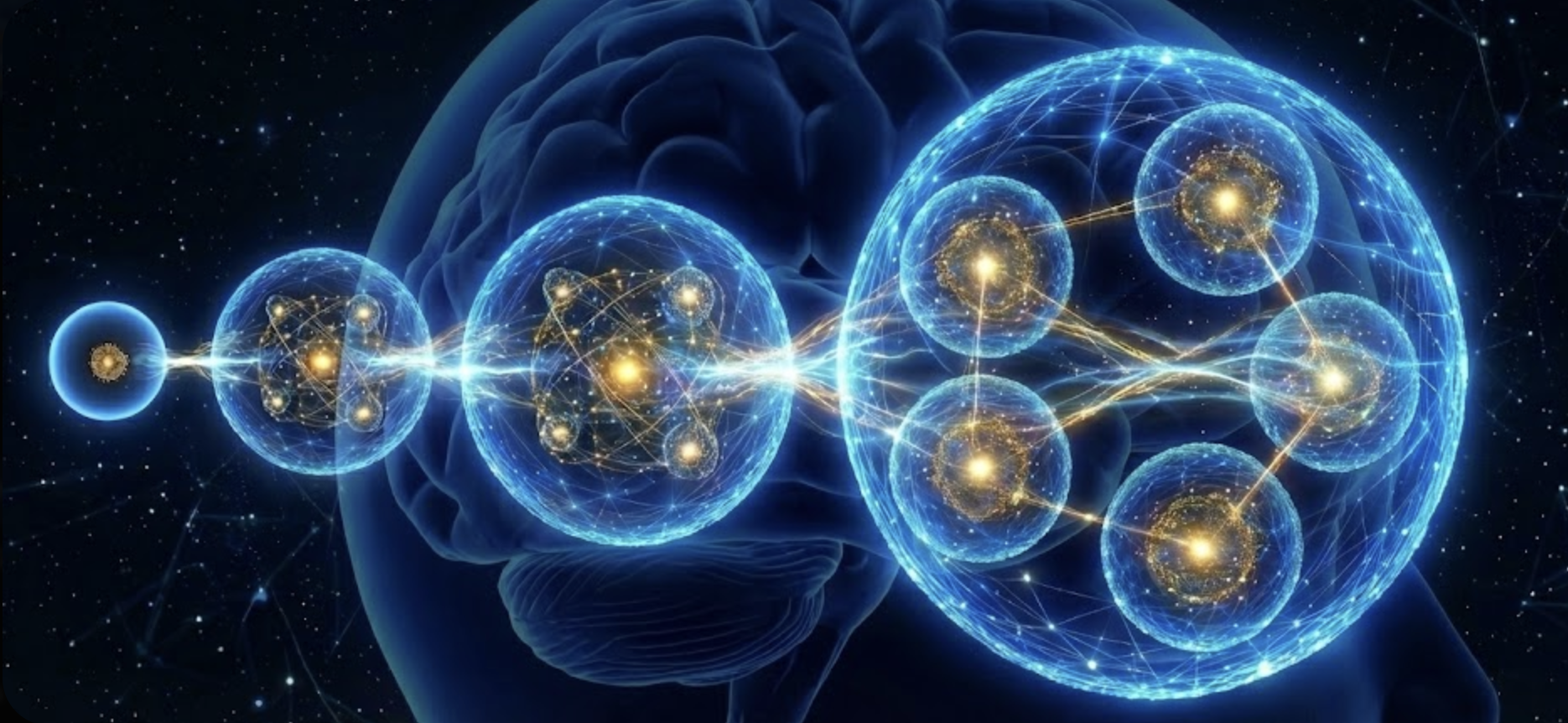
Reality is constructed by nested swarms of information processing nodes.
Look anywhere and you’ll find things inside of things inside of things—and at every level, order is emerging out of chaos. Your mind processes more information than any other animal on the planet, seemingly enabled by trillions of neurons, none of which have any awareness of what they’re doing. The cells composing each neuron have no knowledge of the neuron which they constitute. And yet here you are, reading this sentence and understanding it.
As much information as you can process, it’s practically nothing compared to the amount of information we can process when we combine our efforts with other people inside of organizations. No other life form is even close.
Like a neuron, a human inside a department/corporation/nation, has little awareness of what the organization is doing, and yet that organization is acting with intelligence. These are more than mere networks, they’re swarms; organizations of information processors networked together such that they can process not just quantitatively more information, but qualitatively more, and this happens everywhere at every level.
Everything is Information
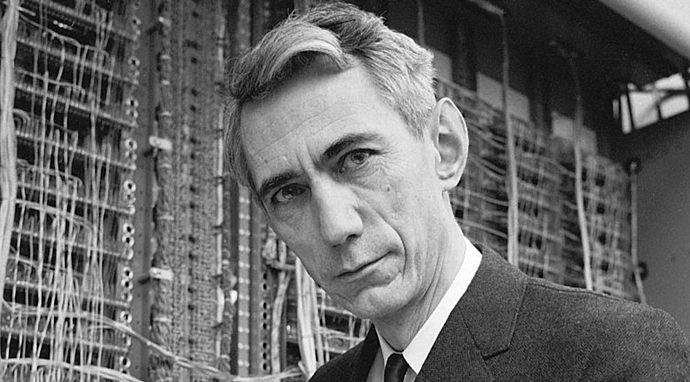
In 1948, a 32-year-old researcher at Bell Labs named Claude Shannon was trying to figure out how to transmit information without noise. To solve this problem, he developed a mathematical framework that would become known as “information theory.”
The story goes that when Shannon showed his equation to John von Neumann, von Neumann told him to call it “entropy”—partly because the mathematical form was identical to the entropy equation in thermodynamics, and partly, von Neumann joked, because “nobody knows what entropy really is, so in a debate you will always have the advantage.”
But this wasn’t just a naming coincidence. Shannon had stumbled onto something profound: the same mathematics that describes how energy disperses in the physical world also describes how information behaves.
Information and physical reality share the same underlying structure.
Decades later, the physicist John Archibald Wheeler would take this insight even further. Wheeler proposed that information isn’t just *like* physical reality—it *is* physical reality. As he put it: “every item of the physical world has at bottom ... an immaterial source and explanation; … all things physical are information-theoretic in origin.”
Wheeler called this idea “it from bit”—the notion that every particle, every field, every physical thing emerges from information.
But how do we get from the idea that reality is fundamentally information-based to the rich physical world we see all around us? What persists when all your atoms are replaced? What are you? What is everything around you?
In the articles ahead, I’ll explore the answers this lens provides to these questions.
What’s Next
This was just the foundation—the core axiom and the hint that information is more fundamental than matter. But a framework is only useful if it actually helps you understand things.
In future articles I will explore this framework by applying it to current events and we’ll go deeper into Wheeler’s revolutionary insight: “It from bit.” The idea that transformed physics in the 20th century and is only now beginning to transform everything else.
From there, we’ll build outward: consciousness, biology, economics, meaning itself. Each article will add a layer to this lens until we have something genuinely useful—a framework that helps you make sense of the chaos, find solid ground, and maybe even see why you matter more than you’ve been led to believe.
If this resonates, subscribe. We’re just getting started.